



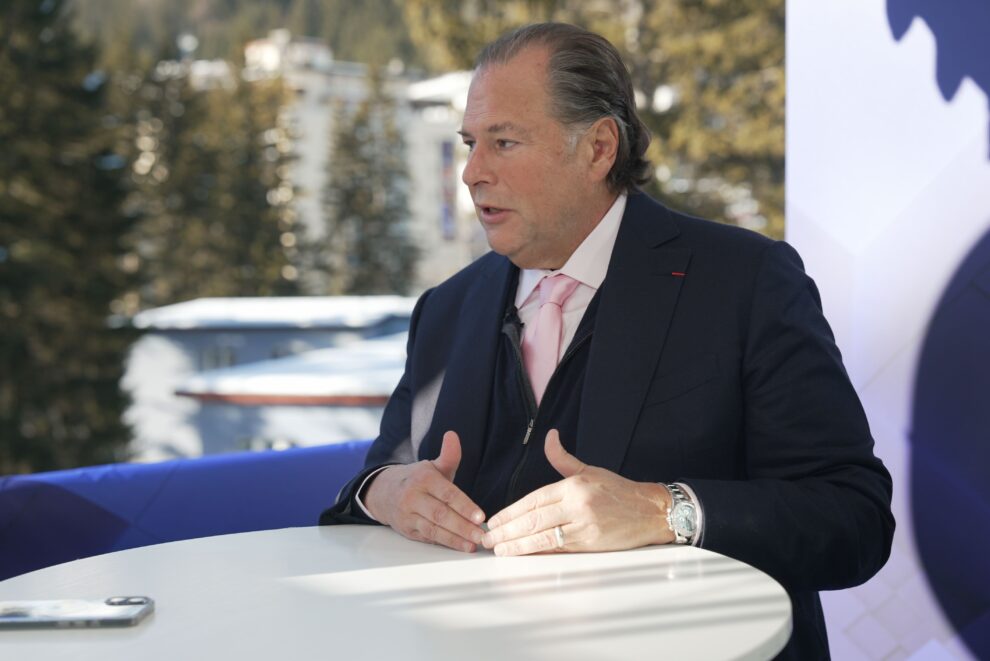

Salesforce on Wednesday evening delivered better-than-expected 2026 fourth-quarter results as its Agentforce artificial intelligence platform became increasingly embedded across the business. However, the stock dropped in after-hours trading as investors remained anxious about the potential of AI disrupting traditional enterprise software companies. Revenue in the quarter ended Jan. 31 rose 12% year over year to $11.2 billion, topping expectations of $11.18 billion, according to LSEG. Adjusted earnings per shar e totaled $3.81, beating the consensus estimate by 77 cents, LSEG data showed. On a year-over-year basis, adjusted EPS increased 37%. CRM YTD mountain Salesforce YTD Shares of Salesforce fell roughly 4.5% in the after-hours session to about $183 and not far from their 52-week closing low of $178.16. Bottom line Salesforce delivered a better than expected quarter, with revenue growth to double-digit territory, driven by strong Agentforce Sales and Agentforce 360 Platform, Slack, and Other sales. Meanwhile, the other three subscription and support revenue line items missed analyst forecasts. As for its important new product Agentforce, the AI-powered platform has closed more than 29,000 deals since its launch and is now an $800 million annual recurring revenue business. On the call, CEO Marc Benioff listed Amazon, Ford, AT & T, Moderna, General Motors, and Pfizer as global brands that have chosen Salesforce to lead their agentic transformation. We also appreciated commentary from the CEOs of SharkNinja and Wyndham Hotels & Resorts on the earnings call about how Agentforce is enhancing their operations. One of management’s gripes is that the market doesn’t understand and fully appreciate Agentforce, so it was refreshing to hear from real CEOs about the positive impact the product has had on their business. SharkNinja spoke about how Agentforce improved its customer service experience, while Wyndham said Agentforce is reducing labor costs and driving millions of dollars of increased revenue. Investing Club reporter Natasha Abellard spoke with SharkNinja’s chief information officer about Agentforce in September 2025 and heard a similar story. The remaining performance obligation (RPO) and current remaining performance obligation (cRPO) were better than expected, but there’s some nuance. The cRPO, which measures contracted revenue expected to be realized in the next 12 months, increased 13% year over year in constant currency, including 4 percentage points from the recently closed Informatica acquistion. That means the organic Salesforce growth was only 9%, which was disappointing to investors who wanted to see double digits. A bigger number would have quieted the bear case that Salesforce can’t grow Agentforce and its core legacy business at the same time. The margin performance was mixed, with GAAP results compressing year over year and missing the Street, while non-GAAP expanded more than anticipated, leading to that healthy adjusted earnings per share beat. Non-GAAP, or adjusted figures, allow companies to exclude certain items deemed as non-recurring. While some may be quick to celebrate the non-GAAP results, heightened scrutiny across the software group could push investors to focus more closely on GAAP, which stands of generally accepted accounting principles. Clearly, the company is sick and tired of seeing its share price fall. It’s one of the worst performers in the S & P 500 down 27% year to date, not including any after-hours move. The drop comes after an awful 2025, too. It’s turned into a nightmare position. We should have moved on from this tiny position long ago, but all we can do now is look forward and monitor for signals that show the business will continue to grow and the stock has gotten too cheap. To that end, we liked how Salesforce repurchased $4 billion of stock in its Q4 and announced Wednesday evening a new program worth up to $50 billion. With a market cap of $180 billion, this figure represents about 27% of the company. Still, the company needed to beat expectations on every single line to push back against the “AI eating software” narrative, and the warts around GAAP margins and organic cRPO growth are not helping the case. Also, revenue and GAAP operating margin guidance for the new fiscal year were a little light. One would think that with the stock down this much from its highs and trading at about 14.5 times the midpoint of its fiscal year 2027 non-GAAP earnings guide would leave some wiggle room. But as we explained earlier Wednesday, the challenge for software companies isn’t so much near-term performance, but rather how investors are willing to value their long-term terminal value. Club analyst Zev Fima and Club report Paulina Likos did a video explaining that dynamic. That’s why we aren’t seeing a “not as bad as feared” reaction. Workday, which is in the enterprise software peer group, managed to reverse Tuesday’s post-earnings, after-hours selloff and finish the regular session on Wall Street higher on Wednesday. However, we’re not ready to call this a new pattern for software just yet and buy this decline in Salesforce. We are maintaining our 2 rating on Salesforce, but lowering our price target to $250 per share from $300 to reflect the price-to-earnings multiple compression happening throughout software. Guidance In Salesforce’s fiscal 2027 first quarter, management expects the following: Revenue in the range of $11.03 billion to $11.08 billion. This midpoint of $11.06 billion was a beat versus the consensus estimate of $11.01 billion. Adjusted EPS in the range of $3.11 to $3.13 a share, which is ahead of the Street’s $3.01 estimate. cRPO growth of 13% in constant currency with Informative contributing 4 percentage points of growth. The FactSet consensus called for about 12.8% cRPO growth. For the full year fiscal 2027, Salesforce expects: Revenue of $45.8 billion to $46.2 billion, which brackets the consensus estimate of $46.1 billion. The revenue guide represents year over year growth of 10% to 11% in constant currency. GAAP and non-GAAP margins are expected to be 20.9% and 34.3%, respectively. Both were below the consensus estimate of 22.0% and 34.9%, respectively. Adjusted EPS is expected to be in the range of $13.11 to $13.19, which brackets the Street’s $13.15 estimate. GAAP EPS was guided $7.85 to $7.93. That’s well below the FactSet consensus estimate of $8.24 Free cash flow is expected to increase 9% to 10% year over year, with capital expenditures representing 1.5% of revenue. (Jim Cramer’s Charitable Trust is long CRM. See here for a full list of the stocks.) As a subscriber to the CNBC Investing Club with Jim Cramer, you will receive a trade alert before Jim makes a trade. Jim waits 45 minutes after sending a trade alert before buying or selling a stock in his charitable trust’s portfolio. If Jim has talked about a stock on CNBC TV, he waits 72 hours after issuing the trade alert before executing the trade. THE ABOVE INVESTING CLUB INFORMATION IS SUBJECT TO OUR TERMS AND CONDITIONS AND PRIVACY POLICY , TOGETHER WITH OUR DISCLAIMER . NO FIDUCIARY OBLIGATION OR DUTY EXISTS, OR IS CREATED, BY VIRTUE OF YOUR RECEIPT OF ANY INFORMATION PROVIDED IN CONNECTION WITH THE INVESTING CLUB. NO SPECIFIC OUTCOME OR PROFIT IS GUARANTEED.