




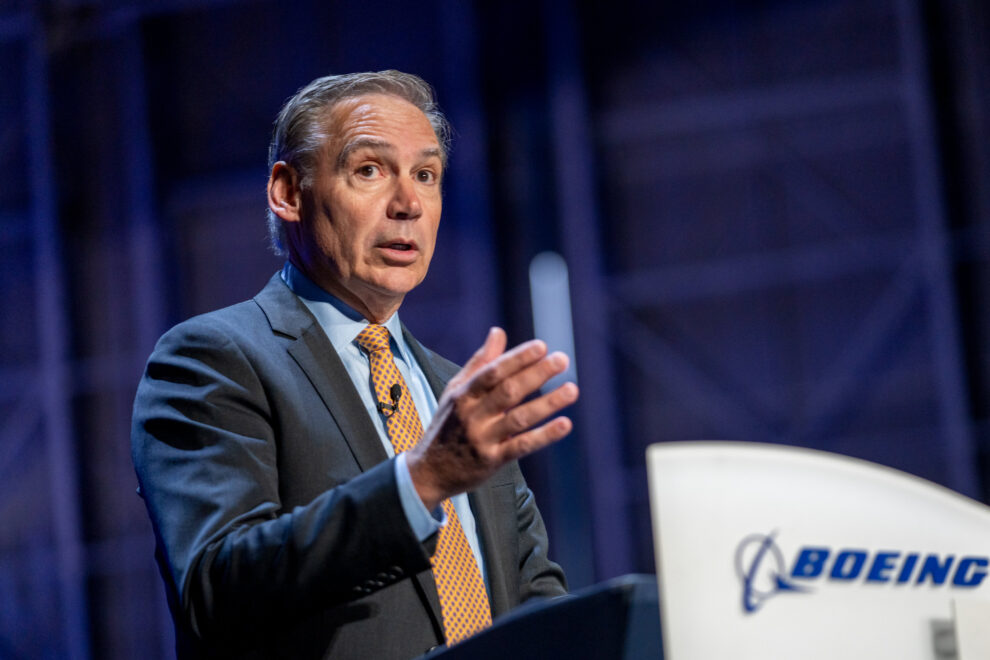

Boeing ‘s stock action on Tuesday illustrated the importance of listening to the post-earnings call with investors. Shares of the aircraft maker sank after releasing quarterly results Tuesday before the bell, thanks to an earnings miss driven by an unexpected loss in its defense business. A few hours later, shares reversed, briefly hitting a 52-week high, after management closed out its prepared remarks on the call by reiterating that its goal of hitting $10 billion in annual free cash flow in the coming years is “very attainable,” and could go even higher. Revenue in the fourth quarter ending Dec. 31 rose 30% year over year to $23.95 billion, topping the consensus estimate of $22.6 billion, according to market data service LSEG. Adjusted earnings per share was $9.92. But that included a $11.83-per-share gain associated with closing the company’s Digital Aviation Solutions transaction. Stripping that out, Boeing lost $1.91 per share. Analysts were expecting a loss of 39 cents, according to LSEG, but it was unclear how our adjustment compared to that estimate. The company delivered $375 million in free cash flow , beating the $111 million FactSet expected. For the entire 2025 fiscal year, Boeing recorded $1.9 billion in free cash outflows, a big improvement over 2024’s outflow of $14.31 billion. BA 1Y mountain Boeing 1-year return Bottom line While this wasn’t the cleanest quarter, it did show progress in the turnaround efforts led by CEO Kelly Ortberg, who stepped into the job less than 18 months ago to save this embattled company. 737 production successfully stabilized at 42 per month, with plans to ramp to 47 per month later this year. Meanwhile, 787 production increased to eight per month as the team works to stabilize that monthly rate. Boeing reported a record backlog, valued at $692 billion. Management also expects full-year 2026 free cash flow to be positive, somewhere in the range of $1 billion and $3 billion. While guidance for the first half of this year remains negative, the back half is expected to turn positive and accelerate sequentially. Those production improvements, coupled with improving free cash flow, tell us the stock should move higher this year. Without earnings to speak of, FCF is the most important metric when it comes to valuing Boeing stock and grading the turnaround because it shows the company’s ability to pay down debt and to fund production. As a result, we are reiterating our buy-equivalent 1 rating and $275 price target, which represents a 11% gain from Monday’s close. Quarterly commentary The fourth-quarter loss of $507 million in the Defense, Space & Security segment, it was driven by roughly $600 million in losses on the KC-46A program. According to the earnings press release, the red ink was due to “higher estimated production support and supply chain costs.” KC-46As are U.S. military aircraft tankers capable of in-flight refueling and supply transport. “While it’s disappointing to recognize another impact on this program, we are seeing encouraging operational performance trends which, if sustained, should enable us to meet our customer delivery commitments and set us up well for the next tanker order,” Ortberg said on the call. On the bright side, Defense, Space & Security revenue rose 37% to $7.42 billion in the fourth quarter. The segment’s backlog increased to a record $85 billion, with 26% of that tied to orders from non-U.S. buyers. Commercial Airplanes revenue surged 139% to $11.38 billion, as deliveries increased 181% year over year to 160 in the quarter. During the quarter, the team booked 336 net orders, driving the backlog to over 6,1000 airplanes valued at a record $567 billion. One new wrinkle to monitor was a comment Ortberg made on the call about how the team identified a potential “durability issue” during a recent inspection on the 777 engine. The team is working with supplier GE to determine the root cause and address it. While this isn’t expected to impact delivery rates in 2027 — certification flight testing can continue — it is nonetheless a negative update we must watch. Global Services revenue increased 1.8% to $5.21 billion. This segment provides services to commercial and defense customers. Sales growth was driven by higher government volumes, while year-over-year operating margin expansion reflected the $9.6 billion gain on the Digital Aviation Solutions transaction noted above. The segment’s backlog increased to a record $30 billion as it secured $28 billion in annual orders. (Jim Cramer’s Charitable Trust is long BA. See here for a full list of the stocks.) As a subscriber to the CNBC Investing Club with Jim Cramer, you will receive a trade alert before Jim makes a trade. Jim waits 45 minutes after sending a trade alert before buying or selling a stock in his charitable trust’s portfolio. If Jim has discussed a stock on CNBC, he waits 72 hours after issuing the trade alert before executing the trade. THE ABOVE INVESTING CLUB INFORMATION IS SUBJECT TO OUR TERMS AND CONDITIONS AND PRIVACY POLICY , TOGETHER WITH OUR DISCLAIMER . NO FIDUCIARY OBLIGATION OR DUTY EXISTS, OR IS CREATED, BY VIRTUE OF YOUR RECEIPT OF ANY INFORMATION PROVIDED IN CONNECTION WITH THE INVESTING CLUB. NO SPECIFIC OUTCOME OR PROFIT IS GUARANTEED.