




The Shell petrol station is at 106 Old Brompton Road in the Royal Borough of Kensington and Chelsea, London, England, United Kingdom, on December 25, 2025.
Nurphoto | Nurphoto | Getty Images
British oil major Shell on Thursday reported its weakest quarterly profit in nearly five years, amid a weaker crude price environment and unfavorable tax adjustments in the fourth quarter.
Shell posted adjusted earnings of $3.26 billion for the quarter, missing analyst expectations of $3.53 billion, according to an LSEG-compiled consensus. A separate, company-provided analyst forecast had put Shell’s expected fourth-quarter profit at $3.51 billion.
It marks Shell’s weakest quarterly result since the first three months of 2021, when adjusted earnings came in at $3.2 billion.
For the full-year 2025, Shell posted weaker-than-expected adjusted earnings of $18.5 billion, compared to annual profit of $23.72 billion a year earlier.
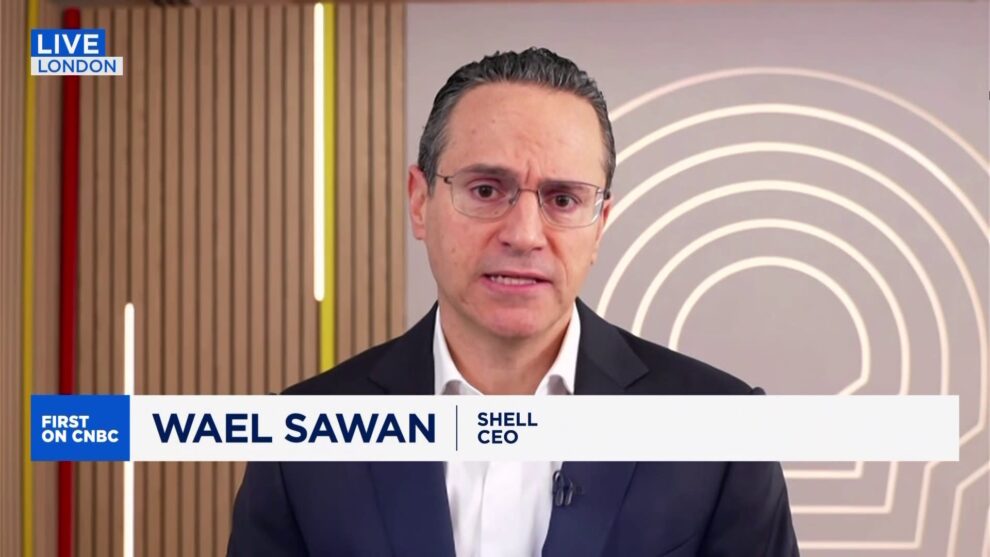
“I’d start off by saying it was actually a very strong operational quarter for us,” Shell CEO Wael Sawan told CNBC’s “Squawk Box Europe” on Thursday.
“A few things hurt us this quarter. Number one was some tax adjustments which went against us, chemicals has indeed been weak, but I would look to the strength actually of our integrated gas, upstream and marketing businesses,” Sawan said.

The company announced a 4% increase in its dividend to $0.372 per share and a $3.5 billion share buyback program, a move that marks the 17th consecutive quarter of $3 billion or more in buybacks.
Net debt came in at $45.7 billion at the end of last year, with gearing at 20.7%. This reflects an increase from net debt of $41.2 billion and gearing of 18.8% at the end of the third quarter.
London-listed shares of Shell traded 1.4% lower on Thursday. The stock is up around 3.6% so far this year.
Performance and returns
The results come as lower oil prices force European energy majors to confront some tough choices.
A challenging market environment, along with expectations for a particularly weak earnings season, had been expected to put the industry’s shareholder payouts at risk.
Norway’s Equinor was the first mover in this sense. The state-backed energy company announced hefty cuts to share buybacks on Wednesday after posting a 22% drop in fourth-quarter profit.
Equinor said it would reduce share buybacks to $1.5 billion this year, down from $5 billion last year, while also trimming investments in its renewables and low-emission energy projects.
“Importantly for investors, Shell continues to prioritise shareholder returns. The company has confirmed a further $3.5 billion share buyback for the first quarter, even as some other European oil majors have opted to scale back distributions,” Maurizio Carulli, global energy analyst at Quilter Cheviot, said in a note.
“Longer term, the key strategic question will be how the company strengthens its reserve replacement ratio, whether through organic development or selective M&A, to underpin future production and cash generation,” Carulli said.
Shell’s Sawan said he came into the job some three years ago looking to drive the performance culture in the company.
“Now, as I look ahead, we still see a lot of opportunities to be able to actually improve our performance,” Sawan said, citing artificial intelligence deployment and supply chain improvements.
“But there [are] also opportunities to actually enhance the returns. And I would say this next phase, you will see us looking to continue to be consistent in our return of capital and you will see us continue to drive an improvement in our return on capital,” he added.
Britain’s BP and France’s TotalEnergies are both scheduled to report fourth-quarter earnings next week.