




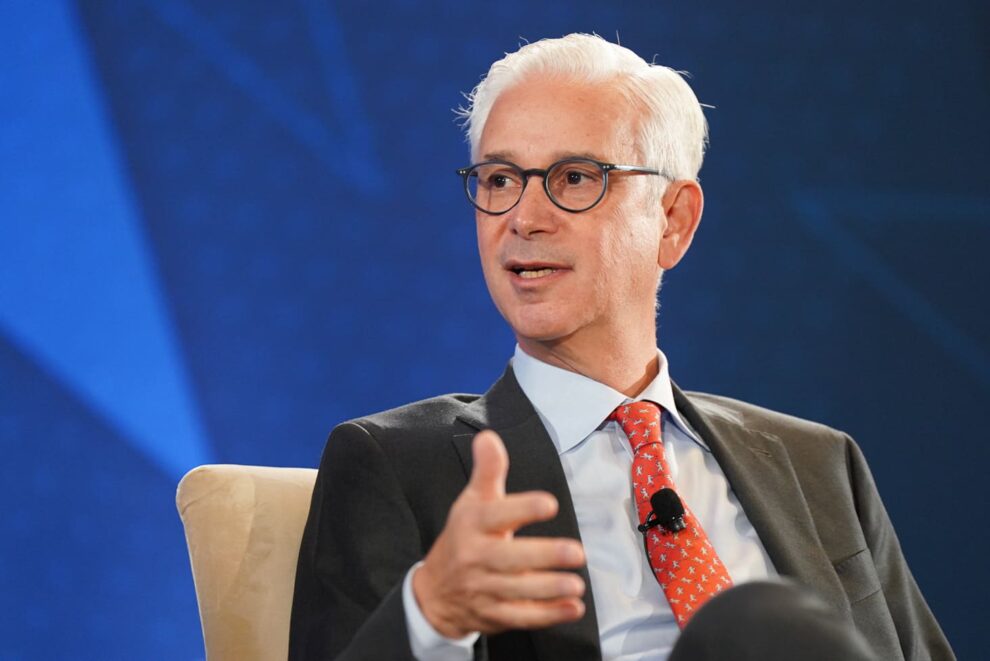

Not a great quarterly report from Wells Fargo , and the stock showed it. The headline fourth-quarter numbers and forward guidance were mixed. Nonetheless, we think that Wednesday’s more than 4.5% drop in shares of Wells Fargo is more reflective of profit-taking in a stock that came into earnings hot than concerns about the year ahead. In fact, we see a strong setup for 2026, the full first year in a long time that the bank will be competing on a level playing field. The $1.95 trillion asset cap imposed on Wells by the Federal Reserve in 2018 for past misdeeds was lifted back in June, thanks to CEO Charlie Scharf’s work since arriving in 2019 to clean things up. WFC 1Y mountain Wells Fargo 1-year return Total revenue at Wells Fargo in Q4 of 2025 increased 4.5% year over year to $21.29 billion, short of the LSEG compiled consensus estimate of $21.65 billion. Earnings per share for the three months ended Dec. 31 rose 13% to $1.62. The consensus estimate was $1.67. The reported EPS reflected a 14-cent headwind due to severance expenses. It’s not clear whether analysts factored this into their estimates. Bottom line The results from Wells Fargo were not what we were hoping for. Fortunately, we did trim our exposure coming into the print, understanding that expectations would be high given the recent rally. That said, we got into Wells Fargo in the first place on the view that the company would turn itself around, following past scandals that predated Scharf, and eventually return to growth as regulator-imposed restrictions were removed. Comparisons to estimates aside, we believe that is exactly what we saw in these results, with more to come in 2026. For starters, Wells Fargo’s efficiency ratio improved on both a year-over-year and sequential basis. Remember, a lower number is better. The bank’s return on tangible common equity (ROTCE) increased year over year, but it was down sequentially. With management’s goal of 15% ROTCE having been achieved, the team previously increased its medium-term target to a return of 17% to 18% on tangible common equity. Tangible book value per share (TBVPS), meanwhile, was up 9% to $45.02, roughly 50 cents ahead of analyst expectations, according to FactSet. These three terms are defined in the notes section of the earnings table below. On the post-earnings conference call, Scharf said that since the removal of the asset cap in the middle of last year, Wells Fargo has been able to drive further balance sheet growth, with assets increasing 11% year over year to close out 2025. Investment banking ambitions at Wells Fargo also appear to be paying off, with Scharf saying, “We’re winning increasingly bigger and more complex assignments. We advised on two of the largest M & A deals of 2025, increasing our announced U.S. M & A ranking to eighth in 2025, up from 12th in 2024. We enter 2026 with our deal pipeline meaningfully greater than it has been at any point in the last five years.” The two biggest 2025 deals, according to Wells Fargo , were Netflix-Warner Bros., and Union Pacific-Norfolk Southern. Wells Fargo returned $5 billion to shareholders in the fourth quarter — buying back 58.2 million shares worth $3.6 billion and paying out another $1.4 billion in dividends. Scharf did say on the call that share repurchases are expected to be lower in 2026, given the many opportunities he and the team see to drive organic growth in the new year now that they are free of the asset cap. Given the results and outlook, we’re bumping our price target up to $100 per share from $96, while maintaining our hold-equivalent 2 rating . Commentary Digging in further, while its common equity tier 1 ratio (CET1) , which measures capital versus risk-weighted assets, did come in a bit light of expectations in Q4, however, still indicated Wells Fargo has plenty of available capital to invest in the business, as it was well above the bank’s 8.5% regulatory minimum. Wells Fargo’s net interest margin (NIM) contracted, though net interest income (NII) still managed to rise year over year as an increase in loan and investment securities balances, and fixed-rate asset repricing, were partially offset by deposit mix changes. NII in Wells Fargo’s markets business also increased in the period. Additionally, the bank closed out the year with higher than expected end-of-period loans and deposits , providing a strong setup in 2026. Why we own it We bought Wells Fargo as a turnaround story under CEO Charlie Scharf. And, he has delivered. His tireless efforts to clean up the bank’s act after a series of misdeeds before his tenure paid off when the Federal Reserve lifted its 2018-imposed $1.95 trillion asset cap in early June. Competitors : Bank of America and Citigroup Weight in Club portfolio : 3.6% Most recent buy : Aug. 7, 2024 Initiated : Jan. 8, 2021 Looking at Wells Fargo’s four operating segments in the fourth quarter: Consumer Banking and Lending saw revenue increase 6.6% year over year. On the call, Scharf said, “We opened nearly 3 million new credit card accounts in 2025, up 21% from a year ago. Credit card balances were up 6% from a year ago. And importantly, we’ve maintained our credit standards.” When asked about President Donald Trump ‘s call for a one-year, 10% cap on credit card rates, the CEO said affordability challenges should be considered, but it’s too early to know. “We’re not quite sure what the ultimate actions … the administration or Congress choose to go down.” Commercial Banking saw revenue fall 3% year over year as an 11% decline in net interest income was only partially offset by an 18% increase in noninterest income. Part of that 11% decline in NII is due to management having “transferred approximately $8 billion of loans and approximately $6 billion of deposits related to certain business customers from the Commercial Banking operating segment to … the Consumer Banking and Lending operating segment” in the third quarter of 2025. That said, lower interest rates also contributed to the decline. Corporate and Investment Banking saw revenue largely flat versus the year ago period. An increase of 7% in total markets was offset by a 4% decline in total banking and a 3% decline in commercial real estate revenue. Wealth and Investment Management saw revenue increase 10% year over year. An increase of 9% in noninterest income on the back of “higher asset-based fees driven by an increase in market valuations,” was compounded by a 16% increase in NII that came as a result of “lower deposit pricing and higher deposit and loan balances.” 2026 guidance Wells Fargo expects 2026 net interest income to increase to $50 billion (plus/minus $2 billion), versus the $47.5 billion realized in 2025 due to “growth in the balance sheet and changes in loan and deposit mix, as well as continued fixed asset repricing.” That compares to the $50.28 billion FactSet estimate. Importantly, the assumptions underlying this guidance included two to three Federal Reserve rate cuts in 2026, a stable 10-year Treasury yield , and mid-single-digit average loan and deposit growth by year-end. Noninterest expenses in 2026 are expected to increase to about $55.7 billion, up from the $54.8 billion realized in 2025. That’s a bit better than the $55.8 billion expected by the Street. (Jim Cramer’s Charitable Trust is long WFC. See here for a full list of the stocks.) As a subscriber to the CNBC Investing Club with Jim Cramer, you will receive a trade alert before Jim makes a trade. Jim waits 45 minutes after sending a trade alert before buying or selling a stock in his charitable trust’s portfolio. If Jim has talked about a stock on CNBC TV, he waits 72 hours after issuing the trade alert before executing the trade. THE ABOVE INVESTING CLUB INFORMATION IS SUBJECT TO OUR TERMS AND CONDITIONS AND PRIVACY POLICY , TOGETHER WITH OUR DISCLAIMER . NO FIDUCIARY OBLIGATION OR DUTY EXISTS, OR IS CREATED, BY VIRTUE OF YOUR RECEIPT OF ANY INFORMATION PROVIDED IN CONNECTION WITH THE INVESTING CLUB. NO SPECIFIC OUTCOME OR PROFIT IS GUARANTEED.