




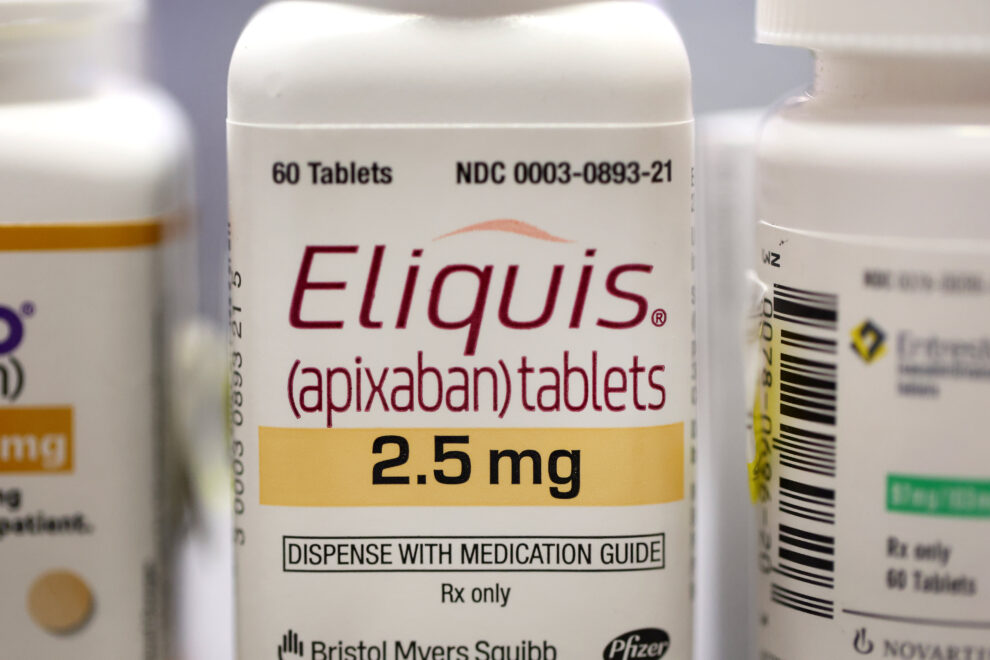

Bristol Myers Squibb on Thursday delivered strong fourth quarter results — and better yet, issued a 2026 forecast that was above Wall Street expectations. Combine that with a single-digit price-to-earnings multiple and the simple fact that this isn’t a software company, and you’ve got the makings of a stock that can keep the momentum going in the current market conditions. Revenue in the fourth quarter ended Dec. 31 ticked up 1% to $12.5 billion, ahead of the $12.28 billion expected, according to LSEG. Earnings per share (EPS) fell 25% year over year to $1.26. However, it still managed to outpace estimates of $1.12, according to LSEG. Shares of Bristol Myers rose more than 1.5% on Thursday, bucking another down day in the S & P 500. The benchmark index is on track for its third negative session in a row and sixth of the past seven, with the heavy selling in software stocks believed to be at risk of AI disruption. Bristol Myers, by contrast, has added more than 6% in that stretch, a reflection of the drug stock’s defensive nature. Bristol Myers Squibb Why we own it: The company’s new schizophrenia treatment Cobenfy has major sales potential, though it remains in the early innings. Bristol Myers has key products, such as blood thinner Eliquis and lung-cancer therapy Opdivo, which will be coming off patent in the coming years. However, we believe its portfolio of growth drugs, including Cobenfy, can help navigate that patent cliff. Initiation: Nov. 25, 2024 Most recent buy date: Feb. 10, 2025 Competitors: AbbVie , Pfizer , Amgen , Johnson & Johnson , and Merck Bottom line Bristol Myers turned in a solid earnings report, with top and bottom line beats and an encouraging 2026 forecast. In the fourth quarter, sales benefited from broad-based strength across multiple drugs, while earnings benefited from better-than-expected margins as the company’s cost-cutting efforts bore fruit. Both research-and-development costs and overhead expenses declined year over year, leading to half a percentage point of adjusted operating margin expansion from 2024. While sales of blood thinner Eliquis, its largest drug, did come up short versus expectations, they nevertheless were up 8% annually on stronger demand. More importantly, Bristol Myers expects the growth of Eliquis to continue — to the tune of 10% to 15% for the full year — despite the impending loss of exclusivity across Europe this year. Analysts came into the print expecting Eliquis sales to decline by 15% in 2026. As a result, management’s full-year sales and earnings guidance beat expectations, even on the low end. Co-developed with Pfizer, Eliquis was one of the drugs subject to Medicare price negotiations under the Biden-era Inflation Reduction Act, which helped explain why the Street was expecting revenues to decline. On the call, Bristol executives said the decision to also lower Eliquis’ commercial list price in the U.S. — alleviating government penalties for drug-price increases that outpace inflation — are tailwinds in 2026, on top of expanding market share. Revenue for Bristol’s overall legacy portfolio — its collection of drugs that are either facing generic competition or soon will be — fell 15% in the fourth quarter to $5.1 billion. The upshot, however, is that the declines were more than offset by the strength of Bristol’s growth portfolio, which notched 17% year over year growth to $7.39 billion. Within the growth portfolio, new schizophrenia drug Cobenfy came up a tad short of expectations, though we aren’t too concerned given how small it is at the moment. Rather, we were encouraged by CFO David Elkins’ comments on the call that “Cobenfy’s uptake has surpassed all schizophrenia comparators and relevant analogs in the first year of launch, and we continue to expect steady growth throughout the year.” On expenses, Bristol delivered on its commitment to deliver roughly $1 billion in cost savings in 2025 and is on track to deliver another $1 billion in savings over the next two years. Looking ahead in 2026, investors will be closely watching Bristol’s jam-packed year of trial readouts, including possibly more than 10 late-stage study updates, with more to come in 2027 and 2028. These are the catalysts that could help Bristol’s stock see further upside because, if successful, they will bolster investors’ confidence in the company’s ability to navigate future patent cliffs in the legacy portfolio. Given the solid quarter, better-than-expected outlook for the current year, and multiple important trial readouts in the months ahead, we are increasing our price target to $62 from $50. However, we are maintaining our hold-equivalent 2 rating for the time being as shares have rallied over 35% since the late October 2025 low. Guidance Here’s how Bristol Myers’ guidance for 2026 stacked up versus the consensus: Revenue in the range of $46 billion to $47.5 billion, better than the $44.16 billion expected, according to LSEG Gross margin of 69% to 70%, below the FactSet consensus of 72.3%. Adjusted earnings of $6.05 to $6.35 per share, better than $6.02 expected, according to LSEG. (Jim Cramer’s Charitable Trust is long BMY. See here for a full list of the stocks.) As a subscriber to the CNBC Investing Club with Jim Cramer, you will receive a trade alert before Jim makes a trade. Jim waits 45 minutes after sending a trade alert before buying or selling a stock in his charitable trust’s portfolio. If Jim has talked about a stock on CNBC TV, he waits 72 hours after issuing the trade alert before executing the trade. THE ABOVE INVESTING CLUB INFORMATION IS SUBJECT TO OUR TERMS AND CONDITIONS AND PRIVACY POLICY , TOGETHER WITH OUR DISCLAIMER . NO FIDUCIARY OBLIGATION OR DUTY EXISTS, OR IS CREATED, BY VIRTUE OF YOUR RECEIPT OF ANY INFORMATION PROVIDED IN CONNECTION WITH THE INVESTING CLUB. NO SPECIFIC OUTCOME OR PROFIT IS GUARANTEED.