


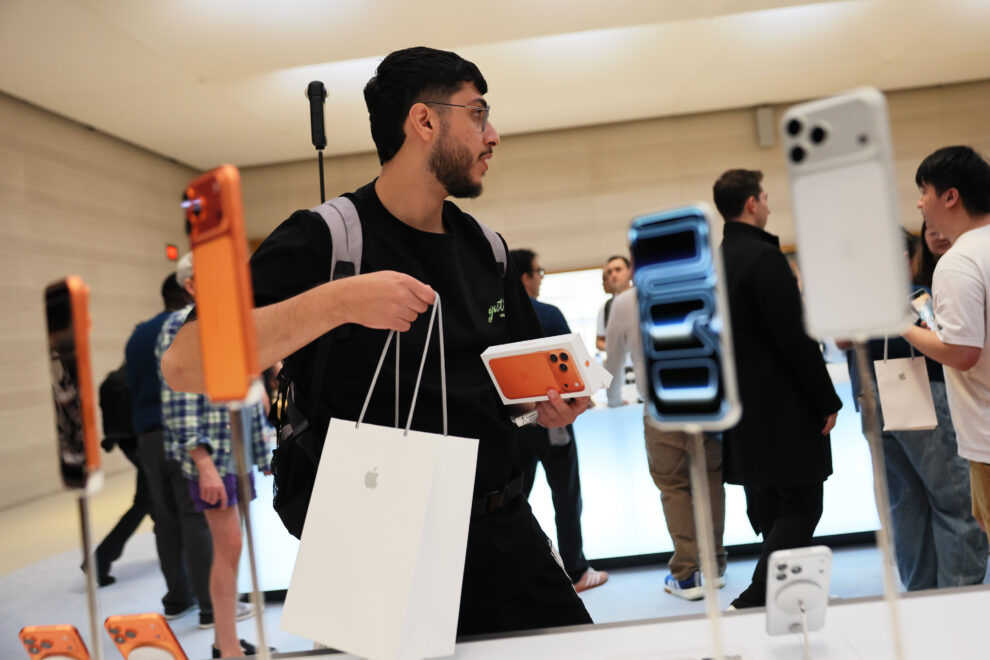

Apple on Thursday evening reported a blowout holiday quarter, driven by a 23% increase in iPhone sales. A strong revenue guide for the current March quarter suggests this strong device cycle will continue. Revenue in Apple’s fiscal 2026 first quarter, which ended back on Dec. 27, rose 16% year over year to $143.76 billion, exceeding the $138.48 billion consensus estimate compiled by LSEG. Earnings per share of $2.84 increased 18% year over year, beating the $2.67 consensus estimate, according to LSEG. AAPL 1Y mountain Apple 1 year Despite the beats and positive outlook, Apple stock was up marginally in after-hours trading. Shares of the smartphone maker have been in a rut lately, logging losses for the past eight weeks in a row. But, as of Thursday’s close, before the print, Apple stock was up 4% so far this week, and finally looks ready to end its losing streak. Bottom line Apple delivered a strong December quarter that topped the mark on the key line items we focus on. The iPhone’s strong results indicate a strong product cycle is underway, while the high-margin Services revenue stream continues to hum along. Notably, sales were strong across all regions, but the biggest upside surprise came from Greater China, where revenue jumped 38% year over year and exceeded estimates by roughly $4.7 billion. It was the best iPhone quarter in Great China’s history thanks to enthusiasm for the iPhone 17 lineup, record upgraders, and double-digit growth from switchers. Gross margins also expanded nicely year over year to levels above where the Street anticipated. That could change in quarters ahead due to skyrocketing memory prices. Memory was the most popular question during the Q & A section of Thursday evening’s earnings call, and CEO Tim Cook explained that it had a little impact on gross margin in the fiscal first quarter. The company expects a little more of an impact in its Q2, but Cook said it’s fully comprehended in the above Street outlook of 48% to 49%. This is a relief for now, but the market won’t stop being worried about memory hurting gross margins until prices come down. Why we own it Apple’s dominant hardware and services businesses provide a deep competitive moat and plenty of bundling opportunities. Management’s net cash-neutral strategy provides confidence that free cash flow will continue to fund dividends and buybacks. Competitors: Samsung, Xiaomi, OPPO, Dell , and HP Inc. Most recent buy : April 8, 2014 Initiation : Dec. 2, 2013 Another point about Apple compared to its megacap tech peers is that its free cash flow continues to grow significantly. Free cash flow was $51.5 billion in the quarter, while Meta Platform ‘s was $14 billion, and Microsoft ‘s was only $5.8 billion. Apple’s playing a different game when it comes to artificial intelligence. Instead of trying to build and train its own large language models, it’s partnering with Alphabet ‘s Google to develop the next generation of Apple Foundation models that will power future features of Apple Intelligence, what the company calls its AI offerings. This preserved cash flow and allowed Apple to repurchase $24.7 billion worth of stock in the quarter. One more thing on Google: We didn’t learn the terms of the AI arrangement Thursday evening, but Cook said the team picked Google because they thought it had the most capable foundation. “We believe that we can unlock a lot of experiences and innovate in a key way due to the collaboration,” he added. With another quarter in the books, we feel a little better about Apple’s current ability to manage memory costs, and the new iPhones are clearly resonating globally, with China not an issue for the time being. If Apple is delivering these results without significant AI-enhancements, we look forward to seeing what the Alphabet partnership can bring to the company. We’ll have to stay flexible with our views based on memory pricing, but Apple sounds like it currently has a good handle on it. While we’re keeping our hold-equivalent 2 rating on Apple stock, we think that evidence of stabilization after eight weeks of losses is a pullback worth nibbling on for those investors feeling they could use more Apple in their portfolios. We’re comfortable with our roughly 4% weighting in Jim Cramer’s Charitable Trust, the portfolio we use for the CNBC Investing Club. We’re also reiterating our $300 price target. Quarterly commentary Products revenue jumped 16% year over year to $113.74 billion in fiscal Q1, beating the estimate of $107.94 billion. The largest source of upside came where it matters most: the iPhone. The smartphone’s sales surged 23% year over year to $85.27 billion, beating estimates by $7 billion. Across the other devices, both Mac and Wearables, Home & Accessories sales declined year over year, while the market anticipated slight growth. iPad sales increased more than expected. Apple’s installed base now exceeds 2.5 billion active devices, creating plenty of opportunities in the future for both upgrades and Services monetization. Product gross margins increased 140 basis points year over year to 40.7%, beating estimates of 40%. Services revenue growth decelerated slightly from 15% in the company’s fiscal 2025 fourth quarter to 13.9% in fiscal Q1, keeping the total revenue of $30.01 billion in-line with Street expectations. The company previously guided growth of around 13.5%, so it was a little better than internal expectations. Services revenue includes revenue streams like Apple TV, advertising, cloud services, music and payment services, and App Store. Service gross margins expanded 150 basis points year over year to 76.5%, beating estimates of 75.8%. Outlook The company’s revenue outlook for the current March quarter (the company’s fiscal 2026 second quarter) exceeded the consensus view. March quarter revenue is expected to increase 13% to 16% versus the year-ago period, a stronger forecast relative to estimates of about 10%. To put some numbers around it, Apple is guiding revenue in the range of $107.76 billion to $110.62 billion. For comparison, the FactSet consensus is at $104.93 billion. The company explained on the call that revenue is expected to grow double digits even as it works through supply constraints in advanced node capacity. Services revenue is expected to grow at a year-over-year rate similar to what Apple just reported, so call it about 14%. That implies sales of $30.375 billion, which is a little bit above the FactSet consensus estimate of $30.26 billion. Companywide gross margin for the March quarter is expected to be between 48% and 49%, exceeding expectations of 47.3% on FactSet. Operating expenses are expected to be between $18.4 billion and $18.7 billion, which is much higher than the FactSet consensus of $17.5 billion. Part of the reason why Apple has increased spending is from research and development (R & D) investments. (Jim Cramer’s Charitable Trust is long AAPL, META, MSFT, GOOGL.. See here for a full list of the stocks.) As a subscriber to the CNBC Investing Club with Jim Cramer, you will receive a trade alert before Jim makes a trade. Jim waits 45 minutes after sending a trade alert before buying or selling a stock in his charitable trust’s portfolio. If Jim has talked about a stock on CNBC TV, he waits 72 hours after issuing the trade alert before executing the trade. THE ABOVE INVESTING CLUB INFORMATION IS SUBJECT TO OUR TERMS AND CONDITIONS AND PRIVACY POLICY , TOGETHER WITH OUR DISCLAIMER . NO FIDUCIARY OBLIGATION OR DUTY EXISTS, OR IS CREATED, BY VIRTUE OF YOUR RECEIPT OF ANY INFORMATION PROVIDED IN CONNECTION WITH THE INVESTING CLUB. NO SPECIFIC OUTCOME OR PROFIT IS GUARANTEED.